Welcome to Whitechapel? Uma cidade dentro da cidade
Welcome to Whitechapel? A City Within the City
24 de agosto de 2026
August 24, 2026
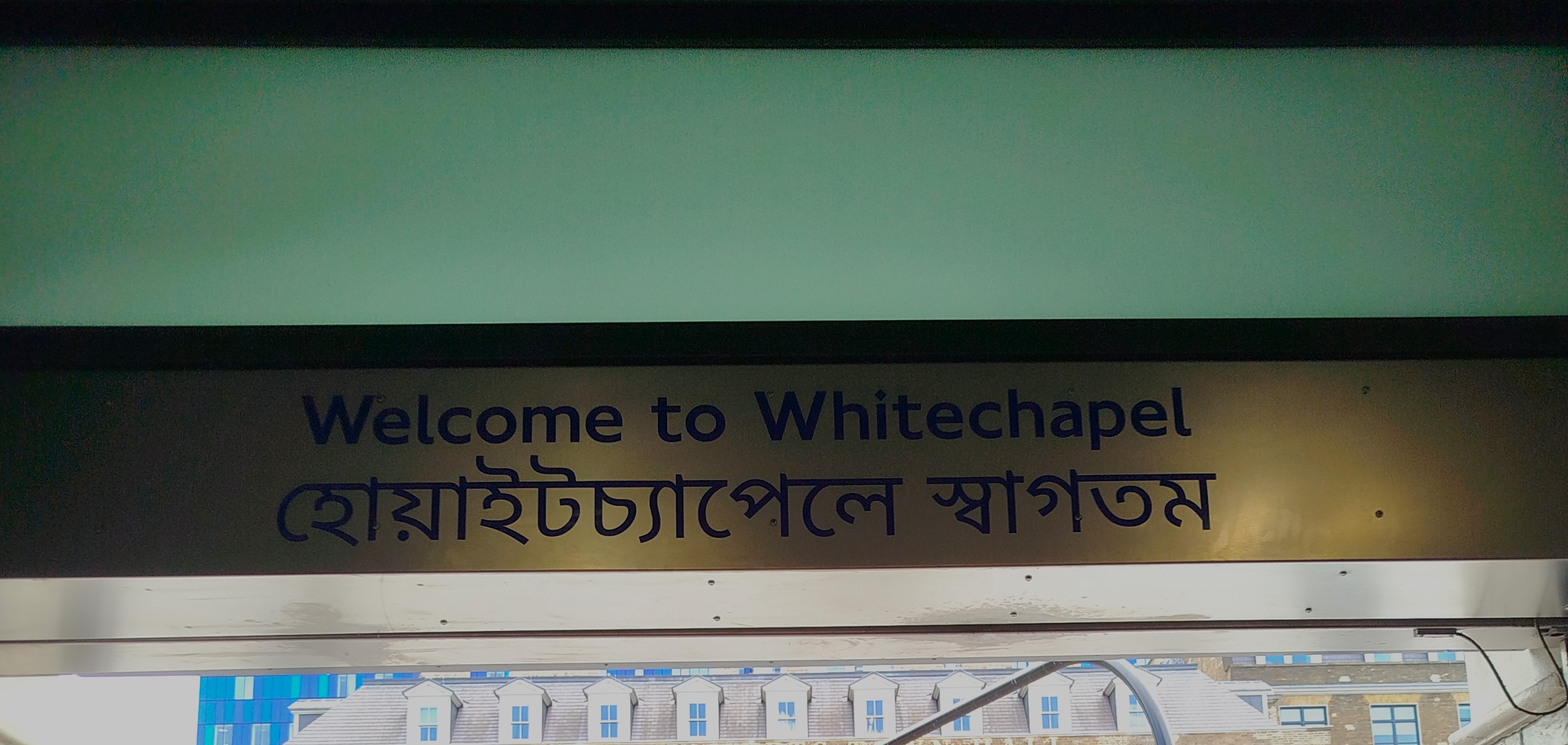
Por alguns minutos, tive a sensação de ter saído de Londres sem ter pegado nenhum transporte. Saí da estação de Whitechapel e a primeira coisa que li foi uma placa: Welcome to Whitechapel. Logo abaixo, a mesma frase numa escrita que li, de imediato, como árabe, e que era, na verdade, bengali. O engano durou pouco, mas foi revelador; volto a ele mais adiante.
Caminhei alguns metros e a impressão se intensificou até virar quase física. O comércio de rua, as vestimentas, a língua nas conversas, os letreiros, a comida exposta nas vitrines, os cheiros de tempero. Tudo parecia produzir uma outra paisagem em relação àquela Londres turística que eu vinha percorrendo minutos antes. Chegamos, por coincidência, no horário do adhan. O chamado à oração saía do minarete da East London Mosque em alto e bom som. Ao afastar-se alguns quarteirões adiante, na direção de Liverpool Street, toda aquela densidade urbana e sonora simplesmente desaparecia, substituída por uma nova forma de densidade, dessa vez em concreto, vidro e altura: o One Bishopsgate Plaza.
O primeiro impulso é definir aquele contexto urbano como segregação, porque a facilidade com que a palavra chega parece proporcional à evidência da paisagem. Mas desconfio dessa facilidade, porque ela responde antes de perguntar. A questão que me interessa, como arquiteta e pesquisadora das relações entre território e justiça espacial, recai sobre os processos urbanos que fizeram, ao longo de séculos, com que essa concentração se tornasse possível, necessária e até desejável para quem a habita. Perguntar por que essas pessoas vivem ali transforma uma comunidade inteira em ré de uma escolha suspeita. Perguntar o que as reuniu ali devolve a questão à cidade, que é de onde ela deveria partir.
Convém delimitar a impressão com números antes que ela se generalize sozinha. Tower Hamlets, o borough onde fica Whitechapel, tinha em 2021 a maior proporção de residentes muçulmanos da Inglaterra e do País de Gales, 39,9%, e a maior população de origem bengali do país, 34,6% (Office for National Statistics, 2023). É a maior concentração nacional, ainda assim, não chega a ser maioria. Em Londres como um todo, os muçulmanos somam cerca de 15%. Mas Whitechapel produz a experiência de uma cidade islâmica sem que Londres o seja em qualquer sentido estatístico. No entanto, a experiência vivida propaga-se mais rápido e com mais força do que os dados. Os discursos discriminatórios exploram essa distância em slogans como Londres virou islâmica, tomando um bairro pela cidade e a cidade pela nação.
O que a paisagem esconde, de todo modo, é a espessura histórica do lugar. Whitechapel e a vizinha Brick Lane são o coração do East End, ponto de chegada de sucessivas ondas migratórias há mais de três séculos, em geral das classes trabalhadoras e das populações deslocadas por perseguição, pobreza ou conflito: huguenotes fugindo da perseguição religiosa no século XVII, irlandeses fugindo da fome, judeus asquenazes fugindo dos pogromos e, no pós-guerra, os bengalis de Sylhet (Beyond Banglatown, s.d.). Há um único edifício que atravessa essa história inteira: na esquina da Fournier Street com a Brick Lane, um prédio foi erguido em 1743 como capela huguenote, virou capela metodista em 1819, sinagoga em 1897 e, em 1976, foi comprado pela comunidade bengali, sendo hoje a Brick Lane Mosque (Historic England, s.d.). Capela, sinagoga, mesquita. A mesma estrutura foi atravessada por quatro diásporas distintas, um mesmo território de chegada e de pobreza.
Se o mesmo território recebeu, por trezentos anos, os sucessivos grupos que a cidade mantinha à margem, então a margem pertence ao espaço antes de pertencer a quem chega. É uma propriedade estável, uma inércia que precede cada nova população e a aguarda. A concentração bengali-muçulmana de hoje ocupa o lugar que ontem foi judaico e antes disso huguenote. A repetição vem da estrutura urbana que as alocou, a mesma em cada época, e os dados de 2021 mostram que ela segue produzindo desvantagem: Tower Hamlets tinha a menor proporção de proprietários de imóveis de toda a Inglaterra e do País de Gales, 16% dos domicílios em superlotação e a maior densidade populacional da Inglaterra (Office for National Statistics, 2023). Pobreza, aperto habitacional e concentração étnica coincidem no espaço. A própria East London Mosque materializa a camada mais recente da história. Concluída em 1985, foi erguida sobre um terreno esvaziado pelos bombardeios da Blitz (Mosqpedia, s.d.), de modo que o vazio da destruição foi preenchido pela infraestrutura de uma comunidade migrante, mais um encaixe da mesma matrioska, agora literal, sobre a ruína anterior.
Aquele engano da placa foi o menor dos meus equívocos e talvez o mais instrutivo. Antes mesmo de olhar com atenção, eu já havia construído uma imagem daquele lugar, uma paisagem que, para mim, se apresentava como "muçulmana" antes de se apresentar em toda a sua complexidade. Percebi o quanto a construção imagética pode preceder o conhecimento e, mais do que isso, condicioná-lo. A imagem que formamos de um território pode funcionar como uma espécie de filtro, seleciona o que vemos, organiza o que reconhecemos e produz pressupostos antes do encontro. O que parecia homogeneidade talvez dissesse menos sobre quem habitava aquele espaço do que sobre os limites do meu próprio olhar.
O nó do problema é ele próprio uma ambivalência. Quando uma comunidade constrói escolas, mesquita, comércio, restaurantes, redes familiares e moradia concentrados num mesmo território, estamos diante de segregação ou de pertencimento? As duas coisas coexistem, mas essa simultaneidade costuma ser achatada como uma narrativa simples. O mesmo território que protege, cria pertencimento e permite viver sem se expor à hostilidade a cada esquina é o que concentra pobreza, reduz os encontros com quem é diferente e reproduz desigualdades ao longo das gerações. O sociólogo Loïc Wacquant (2004) oferece a distinção que me parece decisiva para não confundir as duas coisas, separando o gueto, dispositivo de fechamento imposto de fora como instrumento de controle e confinamento étnico-racial, do enclave étnico, que funciona como abrigo e plataforma para uma comunidade que o construiu como estratégia. A diferença entre eles está na relação de poder que os produz, e não na aparência, que pode ser idêntica, nem na pobreza, que Wacquant trata como traço frequente porém derivado. O enclave é um trampolim voltado para fora, para a integração, ao passo que o gueto é um instrumento de reclusão voltado para dentro. Um se simboliza numa ponte, o outro num muro, e chamar todo enclave de gueto é apagar essa diferença e, com ela, a pergunta sobre quem ergueu o muro.
O que Whitechapel exige, portanto, é recusar tanto a narrativa da autoguetização quanto a da segregação puramente imposta, porque nenhuma das duas dá conta. A concentração ali resulta de uma relação circular entre escolha e coerção, e não de um suposto desejo dos migrantes de se isolarem nem de uma mão estatal que os teria confinado. Uma família pode escolher morar perto de quem fala sua língua, e escolhe assim porque ali encontra moradia que consegue pagar, porque há parentes, emprego acessível, mesquita, comércio halal, escola, e porque sofre menos discriminação do que sofreria dispersa. É uma escolha voluntária na forma e estruturalmente condicionada na origem, de modo que chamá-la de livre escolha é tão falso quanto chamá-la de puro confinamento. A "liberdade", aqui, já vem esculpida pelo mercado imobiliário, pela renda e pela discriminação.
Num paralelo com a França, o país da liberté, égalité, fraternité costuma aparecer na literatura como caso de fracasso de um certo modelo de integração espacial, o dos banlieues e do assimilacionismo republicano, que trata a diferença cultural como assunto privado. O próprio Wacquant (2004) inverte a intuição corrente: para ele os banlieues franceses são anti-guetos, bairros de concentração por critério de classe e não de etnia, culturalmente heterogêneos, cujo problema é a falta de instituições próprias, e não o seu excesso. O contraste útil, do ponto de vista urbano e do direito à cidade, está entre dois regimes de gestão da diferença no espaço, cada um com seu preço, e não entre um modelo que falha e outro que acerta. Por um lado o enclave concentrado e hipervisível, que protege e aprisiona; de outro a dispersão que dilui a comunidade pelo tecido urbano, mas pode dissolver suas redes de apoio e cobrar a integração com a própria cultura.
Na análise lefebvriana (1968/2008), o direito à cidade está em se apropriar da cidade inteira, de circular por ela, de encontrar o outro, de acessar as centralidades onde se concentram as oportunidades e o poder, mas no caso de Whitechapel, a pergunta que se levanta é: se uma comunidade dispõe de uma infraestrutura territorial tão completa que pode viver quase integralmente dentro do próprio circuito espacial, isso é o exercício pleno do direito à cidade ou uma adaptação a uma cidade que nunca lhe ofereceu acesso igual às suas centralidades? Talvez a resposta esteja na justiça espacial de Soja (2010), para quem a injustiça é produzida pelo espaço, pela forma como a cidade distribui distâncias, acessos e barreiras, e não apenas alojada nele como num palco neutro. Isso muda o próprio sentido de integração. Ela não se cumpre quando comunidades diferentes deixam de ter seus próprios espaços, porque a mesquita, o comércio halal, a escola e a rua bengali não são, em si, fracassos; cumpre-se, ou não, na possibilidade de não depender exclusivamente desses espaços para viver a cidade.
Whitechapel não deixou de ser Londres. É uma Londres de várias faces sobrepostas, que coexistem. Uma cidade justa não precisa apagar diferenças culturais para integrar. O problema começa quando origem, religião, renda, moradia, educação e oportunidade passam a coincidir espacialmente com tamanha exatidão que o território deixa de ser escolha e se converte em destino. Antes de discutir quem deveria se integrar, talvez a pergunta mais honesta seja que cidade estamos dispostos a oferecer para que a integração seja sequer possível, e para quem estamos dispostos a abrir a porta por dentro?
For a few minutes, I had the feeling of having left London without taking any transport. I came out of Whitechapel station and the first thing I read was a sign: Welcome to Whitechapel. Just below, the same phrase in a script I immediately read as Arabic, and which was, in fact, Bengali. The mistake was brief, but revealing; I will come back to it.
I walked a few metres and the impression intensified until it became almost physical. The street trade, the clothing, the language of the conversations, the signs, the food displayed in the windows, the smells of spice. Everything seemed to produce another landscape from the tourist London I had been crossing minutes before. We arrived, by coincidence, at the hour of the adhan. The call to prayer came from the minaret of the East London Mosque, loud and clear. A few blocks on, towards Liverpool Street, all that urban and sonic density simply vanished, replaced by a new kind of density, this time of concrete, glass and height: One Bishopsgate Plaza.
The first impulse is to define that urban context as segregation, because the ease with which the word arrives seems proportional to the evidence of the landscape. But I distrust that ease, because it answers before it asks. The question that interests me, as an architect and researcher of the relations between territory and spatial justice, falls on the urban processes that made, over centuries, that concentration possible, necessary and even desirable for those who inhabit it. To ask why these people live there turns an entire community into the defendant of a suspect choice. To ask what gathered them there returns the question to the city, which is where it should start.
It is worth bounding the impression with numbers before it generalizes on its own. Tower Hamlets, the borough where Whitechapel sits, had in 2021 the highest proportion of Muslim residents in England and Wales, 39.9%, and the largest population of Bengali origin in the country, 34.6% (Office for National Statistics, 2023). It is the largest concentration nationally, and still it does not amount to a majority. In London as a whole, Muslims make up around 15%. Yet Whitechapel produces the experience of an Islamic city without London being one in any statistical sense. Lived experience, however, spreads faster and with more force than data. Discriminatory discourses exploit that distance in slogans like London has become Islamic, taking a neighbourhood for the city and the city for the nation.
What the landscape hides, in any case, is the historical thickness of the place. Whitechapel and neighbouring Brick Lane are the heart of the East End, a point of arrival for successive waves of migration for over three centuries, generally of the working classes and of populations displaced by persecution, poverty or conflict: Huguenots fleeing religious persecution in the seventeenth century, Irish fleeing famine, Ashkenazi Jews fleeing the pogroms and, in the post-war period, the Bengalis of Sylhet (Beyond Banglatown, n.d.). There is a single building that runs through this entire history: on the corner of Fournier Street and Brick Lane, a building was raised in 1743 as a Huguenot chapel, became a Methodist chapel in 1819, a synagogue in 1897 and, in 1976, was bought by the Bengali community, and is today the Brick Lane Mosque (Historic England, n.d.). Chapel, synagogue, mosque. The same structure was crossed by four distinct diasporas, one same territory of arrival and of poverty.
If the same territory received, for three hundred years, the successive groups the city kept at the margin, then the margin belongs to the space before it belongs to those who arrive. It is a stable property, an inertia that precedes each new population and awaits it. Today's Bengali-Muslim concentration occupies the place that yesterday was Jewish and before that Huguenot. The repetition comes from the urban structure that allocated them, the same in each period, and the 2021 data show that it goes on producing disadvantage: Tower Hamlets had the lowest proportion of homeowners in all of England and Wales, 16% of households overcrowded and the highest population density in England (Office for National Statistics, 2023). Poverty, housing pressure and ethnic concentration coincide in space. The East London Mosque itself materializes the most recent layer of the history. Completed in 1985, it was raised on a plot emptied by the bombings of the Blitz (Mosqpedia, n.d.), so that the void of destruction was filled by the infrastructure of a migrant community, one more nesting of the same matryoshka, now literal, over the earlier ruin.
That mistake with the sign was the smallest of my errors and perhaps the most instructive. Even before looking closely, I had already built an image of that place, a landscape that, to me, presented itself as "Muslim" before presenting itself in all its complexity. I realized how much the making of images can precede knowledge and, more than that, condition it. The image we form of a territory can work as a kind of filter, selecting what we see, organizing what we recognize and producing assumptions before the encounter. What seemed homogeneity perhaps said less about who inhabited that space than about the limits of my own gaze.
The knot of the problem is itself an ambivalence. When a community builds schools, a mosque, shops, restaurants, family networks and housing concentrated in one territory, are we facing segregation or belonging? The two coexist, but that simultaneity tends to be flattened into a simple narrative. The same territory that protects, creates belonging and allows one to live without being exposed to hostility at every corner is the one that concentrates poverty, reduces encounters with those who are different and reproduces inequalities across generations. The sociologist Loïc Wacquant (2004) offers the distinction that seems to me decisive for not confusing the two, separating the ghetto, a device of enclosure imposed from outside as an instrument of control and ethnic-racial confinement, from the ethnic enclave, which works as shelter and platform for a community that built it as a strategy. The difference between them lies in the relation of power that produces them, and not in appearance, which may be identical, nor in poverty, which Wacquant treats as a frequent but derived trait. The enclave is a springboard facing outward, towards integration, whereas the ghetto is an instrument of seclusion facing inward. One is symbolized by a bridge, the other by a wall, and to call every enclave a ghetto is to erase that difference and, with it, the question of who raised the wall.
What Whitechapel demands, then, is to refuse both the narrative of self-ghettoization and that of purely imposed segregation, because neither accounts for it. The concentration there results from a circular relation between choice and coercion, and not from a supposed desire of migrants to isolate themselves nor from a state hand that would have confined them. A family may choose to live near those who speak its language, and chooses so because there it finds housing it can afford, because there are relatives, accessible work, a mosque, halal trade, a school, and because it suffers less discrimination than it would dispersed. It is a choice voluntary in form and structurally conditioned in origin, so that to call it free choice is as false as to call it pure confinement. "Freedom", here, already comes sculpted by the housing market, by income and by discrimination.
In a parallel with France, the country of liberté, égalité, fraternité tends to appear in the literature as a case of failure of a certain model of spatial integration, that of the banlieues and of republican assimilationism, which treats cultural difference as a private matter. Wacquant (2004) himself inverts the common intuition: for him the French banlieues are anti-ghettos, districts of concentration by criterion of class and not of ethnicity, culturally heterogeneous, whose problem is the lack of institutions of their own, and not their excess. The useful contrast, from the point of view of the urban and of the right to the city, lies between two regimes of managing difference in space, each with its price, and not between a model that fails and one that succeeds. On one side the concentrated, hypervisible enclave, which protects and imprisons; on the other the dispersal that dilutes the community through the urban fabric, but may dissolve its support networks and charge for integration with one's own culture.
In the Lefebvrian analysis (1968/2008), the right to the city lies in appropriating the whole city, in moving through it, in encountering the other, in reaching the centralities where opportunities and power concentrate, but in the case of Whitechapel, the question that arises is: if a community has a territorial infrastructure so complete that it can live almost entirely within its own spatial circuit, is that the full exercise of the right to the city or an adaptation to a city that never offered it equal access to its centralities? Perhaps the answer lies in Soja's (2010) spatial justice, for whom injustice is produced by space, by the way the city distributes distances, accesses and barriers, and not merely lodged in it as in a neutral stage. This shifts the very meaning of integration. It is not fulfilled when different communities cease to have their own spaces, because the mosque, the halal trade, the school and the Bengali street are not, in themselves, failures; it is fulfilled, or not, in the possibility of not depending exclusively on those spaces to live the city.
Whitechapel has not stopped being London. It is a London of several overlapping faces, coexisting. A just city does not need to erase cultural differences in order to integrate. The problem begins when origin, religion, income, housing, education and opportunity come to coincide spatially with such exactness that the territory ceases to be a choice and turns into destiny. Before discussing who ought to integrate, perhaps the more honest question is what city we are willing to offer so that integration is even possible, and for whom we are willing to open the door from the inside?
Referências
Beyond Banglatown. (s.d.). Making home: The world in Brick Lane. https://beyondbanglatown.org.uk/globe/making-home-the-world-in-brick-lane/
Historic England. (s.d.). Brick Lane Jamme Masjid (former Neuve Eglise): List entry 1240697. https://historicengland.org.uk/listing/the-list/list-entry/1240697
Lefebvre, H. (2008). O direito à cidade (R. E. Frias, Trad.). Centauro. (Obra original publicada em 1968)
Mosqpedia. (s.d.). East London Mosque. https://mosqpedia.org/masajid/east-london-mosque/
Office for National Statistics. (2023). How life has changed in Tower Hamlets: Census 2021. https://www.ons.gov.uk/visualisations/censusareachanges/E09000030
Soja, E. W. (2010). Seeking spatial justice. University of Minnesota Press.
Wacquant, L. (2004). Was ist ein Ghetto? Konstruktion eines soziologischen Konzepts (S. Nuss, Trad.). PROKLA, 34(134), 133–147.
References
Beyond Banglatown. (n.d.). Making home: The world in Brick Lane. https://beyondbanglatown.org.uk/globe/making-home-the-world-in-brick-lane/
Historic England. (n.d.). Brick Lane Jamme Masjid (former Neuve Eglise): List entry 1240697. https://historicengland.org.uk/listing/the-list/list-entry/1240697
Lefebvre, H. (1996). Writings on cities (E. Kofman & E. Lebas, Trans. & Eds.). Blackwell. (Original work published 1968)
Mosqpedia. (n.d.). East London Mosque. https://mosqpedia.org/masajid/east-london-mosque/
Office for National Statistics. (2023). How life has changed in Tower Hamlets: Census 2021. https://www.ons.gov.uk/visualisations/censusareachanges/E09000030
Soja, E. W. (2010). Seeking spatial justice. University of Minnesota Press.
Wacquant, L. (2004). Was ist ein Ghetto? Konstruktion eines soziologischen Konzepts (S. Nuss, Trans.). PROKLA, 34(134), 133–147.