Leituras urbanas sob o viés interseccional: Vigilância e estruturas de poder
Urban Readings Through an Intersectional Lens: Surveillance and Power Structures
26 de fevereiro de 2026
February 26, 2026
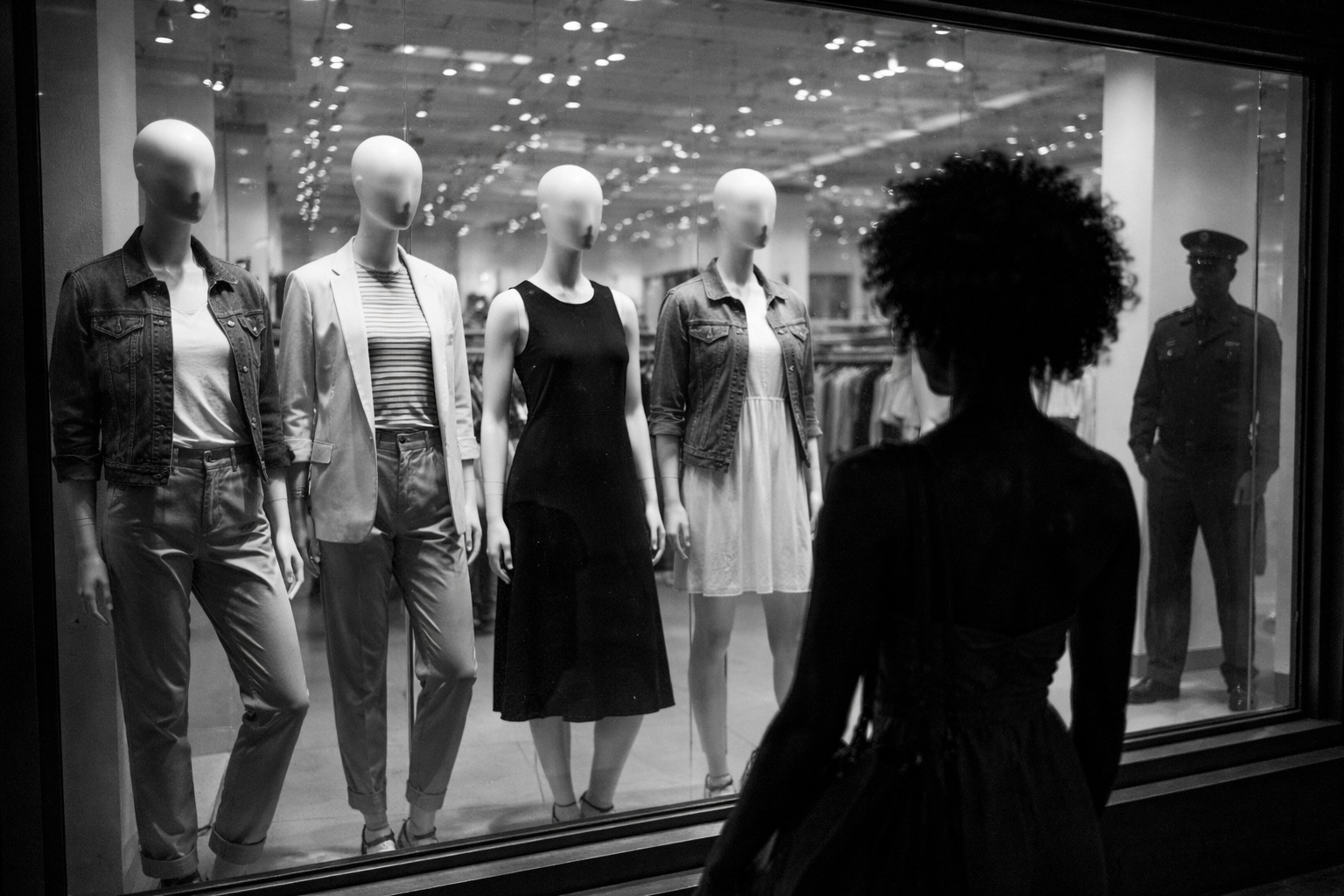
Ontem entrei numa loja da H&M, numa cidade francesa, e o segurança — um homem negro, como eu — passou a me seguir. Onde eu estava, sentia sua presença me rondando, enquanto as outras pessoas, brancas, circulavam sem serem notadas pela vigilância. O que para muitos passaria como um detalhe cotidiano foi, para mim, que trabalho com interseccionalidade, a materialização do que Frantz Fanon (1952) descreveu como a experiência vivida do negro: o momento em que o corpo racializado é "fixado" e transformado em objeto pelo olhar do outro.
Estas experiências urbanas, que tenho sentido com mais força em algumas cidades europeias, revelam uma estratificação social nítida e, de certa maneira, consolidada. Nos espaços de consumo que percorro, os corpos negros ocupam sobretudo lugares de servidão, e mesmo dentro dessa esfera há hierarquias de poder. Num supermercado, não é raro que a recepção e os caixas sejam brancos enquanto a limpeza e a segurança são negras. Como pontua Lélia Gonzalez (1988), os lugares de contato direto com o público tendem a ser vedados a corpos negros, lidos socialmente como "incivis" e mantidos em posições de silenciamento. Parafraseando Kilomba (2008), trata-se de saber quem tem direito à voz. O racismo cotidiano retira a subjetividade, transforma o sujeito negro em objeto do olhar branco e o confina às funções de retaguarda.
Essa organização pode parecer acidental, mas Santos (1996) já afirmava que o espaço urbano não é neutro: ele reflete as lógicas de produção capitalistas. A essas lógicas soma-se a racial. O espaço materializa os valores de uma sociedade que projeta o homem branco como indivíduo "universal" e o corpo negro como elemento a ser permanentemente controlado. Crenshaw e Akotirene (1989; 2018) reforçam que essa vivência é atravessada por marcadores indissociáveis de raça e classe. São eles que decidem, no vocabulário de Lefebvre (1968), quem tem direito à cidade e quem é apenas tolerado nela.
A escolha do homem negro para a função de segurança, se é que se pode chamar de escolha, não se resume à empregabilidade; ela mantém um estereótipo, o do negro como detentor de uma força bruta necessária para conter ameaças ao patrimônio branco. Manifesta-se aqui, da forma mais violenta, aquilo que se depreende de Fanon: a culpa coletiva projetada sobre o corpo racializado. O sistema coopta o corpo negro para vigiar os seus semelhantes e perpetua uma lógica de controle intrarracial a serviço do capital. No Brasil, vemos essa mesma herança na atuação das polícias militares, que reatualizam a função dos antigos capitães do mato, especializados na vigilância e na repressão de corpos negros para a manutenção da ordem escravocrata.
Resta a pergunta de por que ele me seguiu. Não tenho como saber o que se passou na cabeça daquele homem, e o argumento não depende disso, porque a estrutura dispensa a intenção. Num espaço de consumo organizado racialmente, é ela que lhe atribui o papel de vigiar e me atribui o de suspeita, e o roteiro se cumpre antes que qualquer um de nós o escolha. A vigilância constante que senti na loja é o que Gonzalez e Fanon denunciam como a tentativa de nos manter num lugar pré-determinado pela herança colonial. Para a estrutura, eu não era uma cliente; eu era um corpo sob suspeita permanente.
Não se pode ler a sociedade contemporânea e as vivências urbanas sem a lente da interseccionalidade. Para o sistema, o corpo negro no espaço urbano é um "objeto fobógeno", que desperta medo e aversão a partir do esquema epidérmico racial imposto pela branquitude. A resposta a este episódio poderia ser o silêncio e a dor; escolhi o questionamento crítico, fiel às palavras de Fanon: "Ó meu corpo, faça sempre de mim um homem que questiona!".
Yesterday I walked into an H&M store in a French city, and the security guard — a Black man, like me — began to follow me. Wherever I stood, I felt his presence circling me, while the other customers, white, moved about unnoticed by the watch. What for many would pass as an everyday detail was, for me, who works with intersectionality, the materialization of what Frantz Fanon (1952) described as the lived experience of the Black subject: the moment when the racialized body is "fixed" and turned into an object by the gaze of the other.
These urban experiences, which I have felt most acutely in some European cities, reveal a stratification that is clear and, in a way, consolidated. In the spaces of consumption I move through, Black bodies occupy mostly positions of servitude, and even within that sphere there are hierarchies of power. In a supermarket, it is not unusual for the reception and the checkout staff to be white while cleaning and security are Black. As Lélia Gonzalez (1988) notes, roles involving direct contact with the public tend to be closed to Black bodies, read socially as "uncivil" and kept in positions of silencing. To paraphrase Kilomba (2008), what is at stake is who has the right to a voice. Everyday racism strips away subjectivity, turns the Black subject into an object of the white gaze, and confines them to the roles of the back room.
This arrangement may look accidental, but Santos (1996) had already argued that urban space is not neutral: it reflects capitalist logics of production. To those logics a racial one is added. Space materializes the values of a society that casts the white man as the "universal" individual and the Black body as something to be kept under permanent control. Crenshaw and Akotirene (1989; 2018) stress that this experience is crossed by inseparable markers of race and class. It is these markers that decide, in Lefebvre's (1968) vocabulary, who has the right to the city and who is merely tolerated in it.
The assignment of the Black man to the role of security guard, if it can be called a choice, is not reducible to employability; it sustains a stereotype, that of the Black man as the bearer of a brute force needed to ward off threats to white property. What can be drawn from Fanon manifests here in its most violent form: the collective guilt projected onto the racialized body. The system co-opts the Black body to watch over its own and perpetuates a logic of intra-racial control in the service of capital. In Brazil, we see this same inheritance in the military police, which renew the role of the old capitães do mato, the slave-catchers specialized in the surveillance and repression of Black bodies to uphold the slaveholding order.
There remains the question of why he followed me. I have no way of knowing what went through that man's mind, and the argument does not depend on it, because the structure dispenses with intention. In a space of consumption organized racially, it is the structure that assigns him the role of watching and assigns me the role of suspect, and the script plays out before either of us chooses it. The constant surveillance I felt in the store is what Gonzalez and Fanon denounce as the attempt to keep us in a place predetermined by the colonial inheritance. To the structure, I was not a customer; I was a body under permanent suspicion.
Contemporary society and urban life cannot be read without the lens of intersectionality. To the system, the Black body in urban space is a "phobogenic object," one that arouses fear and aversion through the racial epidermal schema imposed by whiteness. My response to this episode could have been silence and pain; I chose critical questioning, faithful to Fanon's words: "O my body, make of me always a man who questions!".